Special Feature: Japanese Brooms
Edo Broom
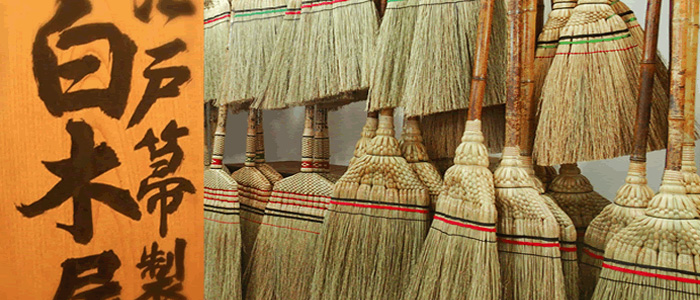
About a ten-minute walk from Tokyo Station, where broad avenues cross narrow lanes among rows of office buildings, stands Shirakiya Denbei. Through the windows stand rows of zashiki brooms—traditional brooms for tatami rooms—quietly apart from the modern cityscape, as if preserving a world of their own.

Mr. Takano of Shirakiya Denbei
“Back in the bubble years, people would react like, ‘A broom? Really?’” says Mr. Takano of Shirakiya Denbei with a laugh.
Perhaps it was an age that made light of tradition. There were years when the shop sold only three to five brooms.
“People often ask how we survived. The truth is, we simply looked up one day and found the others gone. We valued our ties with the artisans, never cut corners, and carefully kept doing what we could. It wasn't so much that we changed—the environment did.”
In 1830, Shirakiya Denbei opened its shop in Kyobashi, in the city of Edo. Edo relied heavily on its canals for transport, and the bamboo gathered along these waterways made Kyobashi a natural center for household-goods shops. These shops dealt in bamboo crafts such as baskets, tatami facing, and many kinds of brooms.
“It seems zashiki brooms were already being sold in Edo by then. Before founding the shop, our family sold water in the area of present-day Ginza. Later, we entered the growing trade of zashiki broom making. As latecomers, we devised a new kind of broom to set ourselves apart, and that is how our business began.”
Column 1: The Origin of the Zashiki Broom
That broom is the kushi-nashi, or pinless, zashiki broom they still make today.
Normally, a zashiki broom is made by passing a bamboo pin through bundles of broomcorn arranged in a row. This remains the mainstream method. The kushi-nashi broom uses no such pin. Instead, the bundles are aligned by the strength of the maker's grip alone, then bound together with thread.
“With the conventional pinned method, the pin compresses the bristles and reduces their natural fullness. The weight gathers at the center, making the broom heavy. By removing the pin, the weight is dispersed, resulting in a lighter design.”
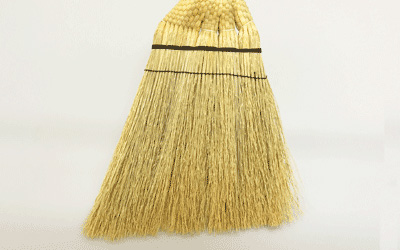
The Kushi-nashi, or Pinless, Zashiki Broom
“Edokko—people born and raised in Edo—are often said to be impatient,” Mr. Takano says with a laugh. “And I think that carried over to cleaning, too. They liked to get things done quickly. So they preferred light, easy-to-use tools over heavy ones. An Edokko would never have swept slowly with a great broom, like the large brooms used in sumo ceremonies.”
It may also be that, with so many people living in a small area, bulky objects were unwelcome and compact brooms were valued. Whatever the reason, the lighter pinless design suited the needs of Edo life.
“What's more, practical-minded Edokko disliked pointless ornament. No amount of decoration makes a broom sweep any better.”
Free of unnecessary decoration, the shop pursued function and practicality above all. That focus raised productivity and met demand—a good match for the Edo temperament.
But as demand for zashiki brooms grew, skilled makers became harder to secure. In the pinless broom, the maker's grip takes the place of the pin. When the grip is released, the weight disperses and the broom becomes light. This means the physical burden on the maker is greater than with a pinned broom, and only a limited number of artisans can make them well.
“Perhaps that is why Shirakiya Denbei has always valued its craftsmen. Other firms paid broom makers by the piece, but we have long used a fixed wage. Even when illness kept someone from making a single broom, they were still paid.”
For Shirakiya Denbei, this meant bearing the risk of keeping craftsmen on. For the craftsmen, it made the shop a dependable partner, and many came to give it priority.
“Today we have three craftsmen,” he says. One of them comes from a family that has made brooms for three generations. Young people still knock on the door hoping to become broom makers, “but few last long,” Mr. Takano notes.
“At heart, many want to be artists rather than craftsmen. They want to express their own sense of beauty, or to be recognized for it. But the essence of this work lies in stepping back from self-expression.”
His words reveal a commitment to guarding tradition while pursuing genuine practicality.
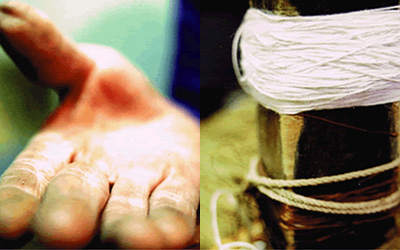
A good broom needs good broomcorn, and Shirakiya Denbei also puts effort into growing it domestically.
Column 2: How Domestic Broomcorn Cultivation Changed Over Time
“The supply is limited, so we cannot use home-grown broomcorn for every broom. But we keep growing it all the same.”
Growing broomcorn is entirely manual work, so few are willing to take it on.
“The harvest is especially hard. Broomcorn grows tall—about two meters—so the air hardly moves, and you end up soaked in sweat. And all of this happens under the blazing August sun. It is farming at its most elemental,” he says with a laugh.
It is far removed from today's mechanized agriculture.
“We originally had it grown in Chiba, but because of issues such as the construction of Narita Airport, it is now grown in Tsukuba.”
From there, he says, comes broomcorn fine enough to rival any grown overseas.
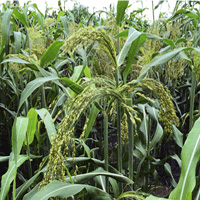
Broomcorn Under Cultivation
Still, the economics simply do not add up.
“Without subsidies, it would not be viable,” he says.
They keep growing broomcorn in Japan nonetheless. What they fear losing is not only the crop itself, but also the fine know-how built through years of trial and error.
“I want to pass the baton cleanly to the next generation, but the world has changed too much. It is like asking a sushi chef to start by going out to catch the fish.”
And there is more. Such know-how was once handed down from early childhood.
“In the old days, if you were born into a farming family, you became a farmer for life. There was no other path. Seen negatively, that closed off other possibilities. Seen positively, it meant you built up that know-how as you grew.”
The Edo and Meiji eras allowed for vast stretches of time—time for trial and error, and time for building the knowledge needed to bring out the best in a material. Today, that time is gone. Everything is demanded at once. In our age, once such knowledge is lost, it can never truly be rebuilt.
And so, even when it does not pay, they continue to grow broomcorn.
The present exists because of its ties to the past. It also exists for what it can pass on to the future.
It makes one wonder: of the things we begin today, will any remain a hundred years from now as tradition?
Lately, Mr. Takano senses signs of change.
“Brooms are selling well even among people in their twenties to forties. People used to clean at the start of the day. Now, many households clean at the end of the day, after coming home.”
But cleaning at night calls for care.
“People in apartments worry not only about noise but also about vibration, and many hesitate to run a vacuum. In that setting, some people feel uneasy when cleaning has to follow the rhythm of a machine. I think they welcome the fact that a broom, analog as it is, lets them clean on their own terms.”
And in today's stressful world, he adds with a laugh,
“A vacuum has its conveniences. But sweeping with a steady rhythm may be what leaves the heart feeling clear.”
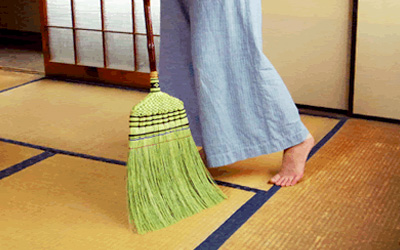
“We make our brooms to be used for a long time, with care. They are not disposable goods meant to fall apart in a year. The very foundation of our craft is different. I do not dismiss disposable products outright. What matters is offering society a range of choices, each suited to its place.”
The bond with an object that comes only with time—attachment—is born through caring for it. And that is possible only with something made to last.
“More and more young people are looking for exactly that,” he says.
Times change, for better and for worse. Once a craft is broken off, all the know-how built up over generations is lost with it. Rebuilding it would take an immense span of time—time our age will not easily grant.
Because they know that danger, Shirakiya Denbei refuses simply to drift with the times. Instead, they guard tradition while living fully in the present.
- Note 1:Securing water was difficult in Edo. In addition to drawing water from the Tama River, selling water itself became a viable trade.
Column 1The Origin of the Zashiki Broom
The zashiki broom came into wide use from the mid-to-late Edo period onward. The broomcorn used to make it is a variety of sorghum called hōki-morokoshi. According to one leading account, it was brought to Japan by the Joseon Tongsinsa, the Korean diplomatic missions to Japan, and its cultivation is said to have taken place near Nerima, on the outskirts of Edo.
Behind the rise of the zashiki broom was the spread of tatami. Before that, shuro palm brooms had been the norm. As tatami, once used mainly by the upper samurai class, spread to the merchant class, living spaces changed greatly. With that change, broomcorn came to be preferred. Its fine bristles could reach into the weave of tatami, unlike shuro palm brooms, which tended to sweep only across the surface.
Column 2How Domestic Broomcorn Cultivation Changed Over Time
From the Edo period until some years after the war, broomcorn was actively cultivated in Japan. It was grown alongside rice as a cash crop. In an age when crop breeding was far less advanced than it is today, a farmer's livelihood depended heavily on the rice harvest. A crop that could be turned into cash was therefore a true lifeline. Broomcorn suited this role well. It could be harvested early, grown alongside other crops, and processed after the main harvest was over.
Today, sadly, almost no farmers grow broomcorn. Its cultivation has never been mechanized, so the work remains entirely manual and demanding. But perhaps more than that, another form of supplementary income appeared: salaried work alongside farming. This shift in lifestyle seems to have had a major impact on broomcorn cultivation.
Column 3New Ventures at Shirakiya Denbei
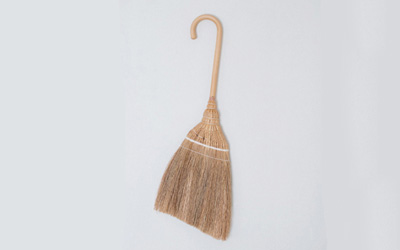
The Umbrella-Handle Broom
Working with a product designer, the shop released a broom about six or seven years ago with a handle curved like the crook of an umbrella. The handle is made of rattan, which bends easily. The curve also makes the broom easy to hang, for example on a doorknob. By adding ease of storage to its basic function, they created a broom suited to the modern home.
The Harimi Dustpan
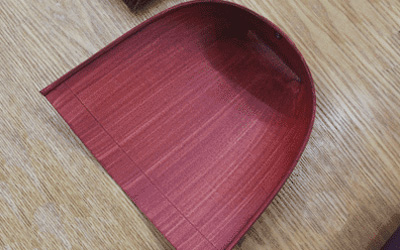
The Harimi Dustpan
A harimi is a dustpan made of thick paper coated with persimmon tannin, or kakishibu, for strength, and reinforced with a bamboo frame. Harimi were originally made as a side trade in the Hokuriku and Jōetsu regions. The name is said to come from hari-awaseta mino, meaning a “patched-together straw raincoat.”
Unlike a plastic dustpan, it does not generate static electricity, so dust and debris do not cling to it. Its thin leading edge is another advantage, leaving little behind as you sweep. When you press the handle down—the natural motion used to sweep dust in—the mouth opens. When you release it, the mouth narrows, as if gathering the dust into its arms. It is a dustpan that makes the most of its natural materials.