Special Feature: Japanese Brooms
Shuro Broom
The story of Yamamoto Katsunosuke Shoten begins in 1880, with shuro—a durable fiber taken from palm bark—and with a family seeking a new path as the trade in traditional Japanese candles, or warōsoku, began to fade. The founder, Katsunosuke Yamamoto, was nineteen at the time. He turned from the family's former trade to mountain goods, and eventually built the business around the production and sale of shuro.
“Katsunosuke Yamamoto took over just as the family trade was failing. As a way to turn things around, he set out to expand shuro production and open new markets for it. From there, through many twists and turns, we have come to today. We are the fourth generation, and I believe what matters is carrying this tradition forward,” says Mr. Tsuchida.
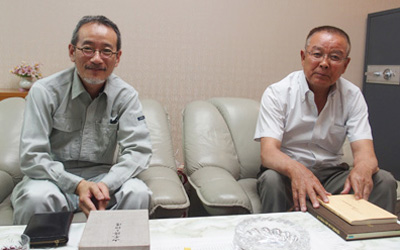
From left: Takashi Tsuchida, fourth-generation head of Yamamoto Katsunosuke Shoten; Norikazu Asano, Executive Director and Secretary-General of the Kainan Specialty Household Goods Cooperative Association
The Nokamidani region of Wakayama Prefecture, where Yamamoto was born (see Note 1), had long been known for shuro. In the Edo period, its bark was stripped and shipped as raw material to Edo and Osaka. Shuro was valued because it resisted water, resisted rot, and could be worked into everyday tools that supported daily life.
“In the Edo period, shuro was used as a base material for walls. Shuro rope was used to tie together the bamboo lattice beneath the plaster. It resists rot and stands up well to water.”
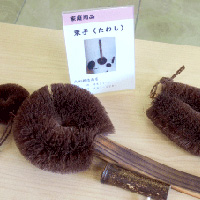
From the mid-Meiji period, shuro processing flourished in Nokamidani, the region where the raw material was produced. As Yamamoto expanded sales nationwide, he became the first in the area to introduce machinery.
“Around 1907, shuro rope for fishing nets was our mainstay. Katsunosuke Yamamoto traveled from fishing port to fishing port across Japan to sell it. His method was much like that of the medicine peddlers of Toyama: he would leave the nets with the customer and collect payment only for what had been used. Shuro rope was strong and water-resistant, so demand was considerable. As sales grew, production could no longer keep up, so he brought machinists from Osaka and began mechanizing the making of shuro rope.”
Mechanization greatly increased supply. So much so that local cultivation (see Note 2) could no longer keep pace, and at the height of the boom, shuro was gathered from all over Japan. As the years passed, Nokamidani prospered greatly from shuro, and people's lives became more secure.
After the war, however, shuro entered a period of sharp decline. Lifestyles changed, and with the spread of plastic goods, shuro—once used in all kinds of household items (see Note 3)—came to be used far less (see Note 4).
“Sadly, almost none is grown now.”
As demand declined, the shuro of Nokamidani was replaced by cedar and cypress, and today only a few firms still carry out shuro processing.
“Across Japan, it has almost disappeared. If we do not continue, it will vanish entirely. We feel a responsibility to carry it forward.”
Shuro had taken root as a Japanese tradition by opening up new uses and new markets. Yet after the war, it struggled to survive through changing times. Their feelings could not be expressed by responsibility alone, but they continued making shuro goods all the same.
And then, once more, the times changed. Today, Yamamoto Katsunosuke Shoten deals mainly in shuro brooms, which Katsunosuke Yamamoto began handling late in his life. Once in sharp decline, the shuro broom now receives more orders than they can keep up with.
“I think people are drawn to its distinctive texture.”
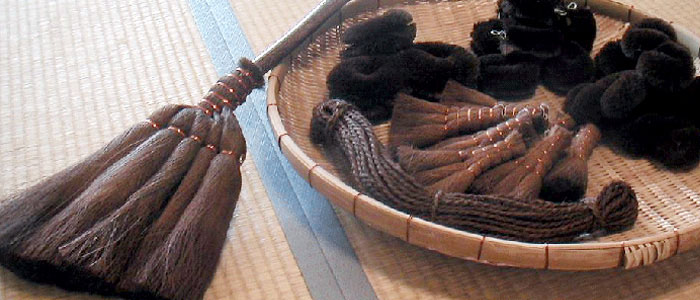
Originally (see Note 5), shuro brooms were used to sweep wooden floors. With the spread of modern flooring, they are now being rediscovered. The most popular type is the onige broom (see Note 6).
“An onige broom is made by combing the fibers again and again, then gathering only those that remain. People sometimes call them thick, but that is only in comparison with shuro fiber as a whole. The strands themselves are finer and more supple than the shida fiber used in garden brooms.”
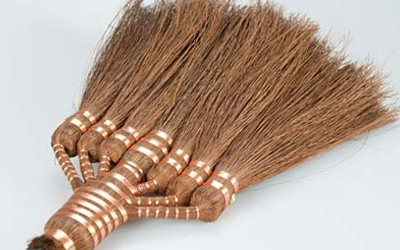
The onige-type shuro broom
Its strengths are durability, water resistance, and the ability to gather fine dust gently and cleanly from the floor.
“Even if fine dust is spread across the floor, it sweeps cleanly without leaving streaks.”
With long use, the natural oils in shuro are said to bring a subtle sheen to wooden floors.
“It does contain natural oils, so if you use it enough, a sheen will appear—though you really have to put it to use,” he says with a laugh. “Use it as much as they do at a temple, and the shine will come.”
In any case, it is one of the brooms best suited to sweeping wooden floors. Once again, the times are beginning to shine a light on tradition.
Mr. Tsuchida is determined to keep production in Japan.
“I would like to use domestic materials as well, but the cost is far beyond reach. The price gap between domestic and imported shuro bark is about twentyfold, as of 2015. It simply does not add up.”
What is more, hardly any shuro is grown in Japan today. Even if it were planted now, it would take ten years before the bark could be stripped (see Note 7).
“The raw material can come from China. What I want to keep here in Japan is the making. Katsunosuke Yamamoto lived by a motto of coexistence and shared prosperity. I am told he supported apprentices who went out on their own, and worked actively with local farmers as well. We have grown together with our community. I take pride in that way of living and thinking, and in the business that came from it. I want to continue producing in Japan.”
The times can be both harsh and kind to tradition. They may turn away from what has long been valued, only to rediscover it when life begins to need it again.
What matters, perhaps, is not simply preserving the past, but continuing to make it useful in the present.
That, it seems, is what Yamamoto Katsunosuke Shoten has shown us.
- Note 1:The area that includes present-day Misato Town, Kimino Town, and Kainan City was once called Nokamidani. Today it is known as the Kainan area.
- Note 2:Growing Shuro: Shuro is a hardy and vigorous plant. Its bark can be harvested after seven or eight years, and seeds that fall to the ground readily sprout again. The abundance of shuro on the Kii Peninsula is thought to be due to the region's heavy rainfall, relatively mild climate, and sloping terrain—conditions under which shuro came to grow in dense stands.
- Note 3:Typical Uses of Shuro:
- Bark: rope, nets, mats, floor coverings, brushes, brooms, straw raincoats, sandal thongs, and floor mats
- Outer bark: coarse brooms and coarse scrubbing brushes
- Young leaves: summer hats, Sanada braid, round fans, and conical hats
- Mature leaves: fly swatters, dusters, and round fans
- Trunk: railway sleepers, temple bell-strikers, alcove posts, and picture frames
- Note 4:The Rise and Fall of the Shuro Industry: As noted above, shuro saw great demand as a building material in the Edo period, and records show that raw material was shipped from Kii Province to Edo. In the Meiji era, processing flourished in Wakayama, the production region. New uses were developed and output rose sharply, peaking around 1920. It then declined for a time as substitutes such as Chinese goods and palm fiber were imported. Around World War II, however, the controlled wartime economy cut off these imports, and demand for shuro increased again. After the war, overharvesting during the war years had damaged and weakened the trees, causing shortages of raw material. At the same time, substitutes such as palm fiber and plastic rose rapidly. As a result, demand for shuro fell sharply, and it remains low today.
- Note 5:The shuro broom appears in Kefukigusa, a treatise on haikai published in 1645.
- Note 6:Onige and Kawa Shuro Brooms: Shuro brooms come in two types: onige and kawa, or bark. Freshly gathered shuro forms a single sheet of intertwined fibers. In the kawa type, these sheets are rolled, set side by side, and bound, with only the tips loosened. In the onige type, the sheet is teased apart, the bark between the fibers is removed, and each fiber is reduced to a single strand before being bound. The kawa type is stiffer, while the onige type is smooth, almost like a writing brush.
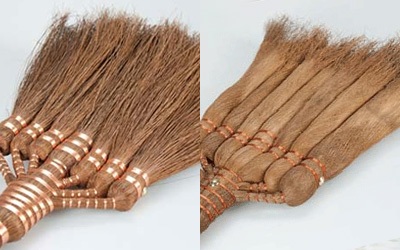
Left: Onige-type shuro broom / Right: Kawa, or bark-type, shuro broom
- Note 7:Harvesting Shuro Bark: A shuro palm is said to reach a suitable height of about 1 to 1.5 meters eight or nine years after planting. At that point, the lower leaf stalks have died back to around 50 centimeters, so a first stripping is done as part of upkeep. The next year, four or five sheets are taken. From the following year, regular stripping begins. In the past, it was said to be best to strip one sheet each month. In practice, however, the bark is usually stripped once a year, in spring or autumn. Spring stripping is preferred because it yields thicker, broader, higher-quality bark, with eight or nine sheets gathered during the spring season.