Special Feature: Japanese Brooms
Kanuma Broom
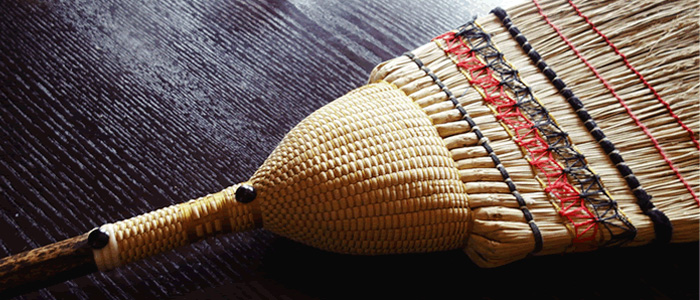
Kanuma City, in Tochigi Prefecture, was once known throughout Japan for its hamaguri-gata, or clam-shaped, zashiki brooms—traditional brooms for tatami rooms—as well as for the broomcorn grown to make them. Its history runs deep.
Broomcorn cultivation (see Note 1) in Kanuma is said to have begun in 1841, when Arai Kiemon, the magistrate of Kamidono, brought broomcorn seed back from Nerima in Edo and planted it in Hanaoka Village, near what is now Murai-machi in Kanuma. Through repeated improvement of the crop, Kanuma grew, from the Meiji era to the years before the war, into one of Japan's foremost broomcorn-producing regions (see Note 2).
Kanuma was also a town of woodworking. When Nikkō Tōshō-gū Shrine was built, gifted shrine carpenters were summoned from across the country. This helped foster a refined sense of beauty in craft—including broom making, where the pursuit of beauty grew especially strong. Contests were once held to see who could make the most beautiful clam-shaped broom in the shortest time.
“Minoya, the house that controlled the broomcorn trade, is said to have ranked its craftsmen and set them in competition, encouraging them to make brooms that were both stronger and more beautiful.”
As the craftsmen sharpened one another's skills, the form of the clam-shaped broom was refined, and the broomcorn improved along with it. Together, these forces built the Kanuma broom into a respected name. Outstanding in both beauty and function, it became widely admired in its time.
Yet the times changed dramatically. With the spread of electric vacuum cleaners from the late 1950s onward, demand for zashiki brooms fell sharply. The once-flourishing Kanuma broom came to be made only rarely, and today only a handful of broom makers remain (see Note 3). Those who still grow broomcorn are almost nonexistent.

Ms. Sanae Maruyama
Amid all this, Ms. Maruyama, a Kanuma broom maker, works to keep the tradition alive. She makes the brooms herself and, in pursuit of the fine bristles they require, still grows the broomcorn as well. With nature and the environment now changed, growing broomcorn is a continual process of trial and error.
“As the sudden cloudbursts show, the climate has fundamentally changed,” she says. The old methods can no longer be applied exactly as they were. “The hard part is judging when to harvest. There used to be a saying, ‘broomcorn, seventy-five days,’ meaning about seventy-five days from sowing to harvest. Now there is no predicting it. We harvest by watching the condition of the heads.”
The work continues after the harvest. “Once cut, we dry each stalk one by one in direct sun for three days and three nights. The heads must not overlap, or some parts will not dry through. Drying them on concrete is quicker, but it bends the bristles, so we do not do that. We lay them on soil or on stones by the river instead.”
The reason she continues to grow broomcorn despite such labor lies in the Kanuma broom itself. To form its signature clam shape, large quantities of long-tipped bristles are needed. “With the hand spread wide, we use bristles about two spans of a man's hand—or two and a half of a woman's—in length,” she says. These long bristles form the broad sweeping end of the broom. “Bristles like that are scarce, so you might call it a rather extravagant broom,” she adds with a smile.
A Kanuma broom uses not only the tips but the stalks as well, so the whole plant must be supple yet strong enough to be woven well. In short, a fine Kanuma broom is impossible without fine broomcorn. Precisely because it is a broom made in pursuit of beauty, and precisely because its tradition must be preserved, Ms. Maruyama continues the painstaking work of growing it.
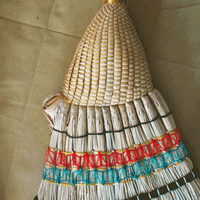
The front of a Kanuma broom
The Kanuma broom that so captivates Ms. Maruyama owes its appeal not only to the broomcorn, but also to the craft worked into the broom itself. “Did you know that a Kanuma broom has a front and a back?” she asks.
Along its side is a small projection called the “ear.” Inside it, the bristles that are not meant to show are tucked away. When sweeping, the side with the ear on the right is considered the “front.”
“Every join is brought to the back, so the front comes out as clean as possible.”
In a master's hands, however, even the back is finished so beautifully that, without the ear, you could hardly tell front from back.
She continues:
“In weaving the stalk of each bristle, we use a distinctive old tool called a karasaki to split the stalk six times in all. The structure tightens little by little as it nears the base of the handle.”
This step, she says, gives the whole broom its beauty.
It is said to take at least three years before a Kanuma broom maker can produce work fit to be shown. Of that time, one year is spent on the karasaki alone—training the eye to read the fibers and learning to split them cleanly and straight.
“There is a saying: anyone who can make a clam-shaped broom can make the others, but not everyone who can make the others can make a clam-shaped one.”
The difficulty of mastering the craft is clear.
A question naturally arises: why did Ms. Maruyama choose to enter such a demanding craft?
“When I was little, I often played in the broom workshop. But the direct trigger was my grandmother's death. After that, my grandfather said he would stop making brooms. I was worried, so I began stopping by every day and helping out while I was there. That is how it started.”
Once she began, she was quickly drawn in. Broom making, she says, became endlessly absorbing.
Part of it may also have been the shock of seeing zashiki brooms in a Tokyo home-improvement store.
“A broom is something you buy once in a generation, not a throwaway to replace year after year.”
Having grown up with the real thing close at hand, she felt the danger in today's flood of poorly made brooms. That, perhaps, lit her resolve to protect the Kanuma tradition.
Her path, however, was not without grief.
In June, two years and ten months into her training, her grandfather and master passed away, leaving her stunned. It was Mr. Araki, another maker of clam-shaped brooms, who took on the rest of her training.
“I am here today because Mr. Araki, who makes clam-shaped brooms in Tsuga, took me under his wing. And the relative who taught me to grow broomcorn also passed away that December—but only just after he had finished teaching me how to harvest.”
By the narrowest of margins, the tradition passed surely into her hands.
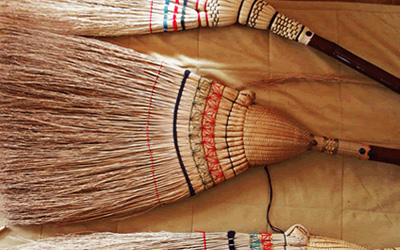
A Broom Made by Ms. Maruyama's Grandfather (center)
Several years have passed, and Ms. Maruyama still makes clam-shaped brooms in Kanuma. Her efforts are as described above.
“Compared with the brooms my grandfather made, I still have a long way to go. And I want all kinds of people to know that craft like this still lives in Japan today.”
Not long ago, when high-school students visited her workshop, one of them asked, “Wait—brooms are made by hand?”
The question drew a wry smile from her.
To preserve the traditional Kanuma broom, and to make an even better one, Ms. Maruyama continues her trial and error to this day. Through it all, her smile remains remarkably bright.
- Note 1:The broomcorn plant is called by names such as hōki-morokoshi and hōki-kibi, though which name is strictly correct is unclear. Both belong to the grass family. One possibility is that hōki-kibi refers to Kanuma's much-improved variety, while hōki-morokoshi refers to the original stock, though this remains speculation.
- Note 2:Kanuma's rise as a broomcorn center likely owed something to the local soil and climate. The soil here, known as Kanuma soil, drains well and is well suited to broomcorn cultivation. As Ms. Maruyama puts it, “Good drainage and sunlight are the key.” These conditions, working together, are thought to have produced the long-tipped, supple, durable bristles for which Kanuma broomcorn is known. It was likely this very material that made possible the distinctive clam-shaped broom, woven from the stalks.
- Note 3:Even a skilled craftsman is said to need at least five hours to finish a single clam-shaped Kanuma broom—with no break at all once the weaving begins. Because such craft shows in every part, the brooms are costly as well. This, combined with the sharp decline in demand, is thought to be one reason their makers have dwindled so greatly.